 Storyline & Sinker
Content creationResearch
How research changed a real estate agent’s content plan
Research shifted the planned audience for the agent’s ongoing content toward homeowners weighing their next move, while expired listings stayed first for direct outreach. The production plan that followed set out 24 vertical videos, each designed to show a recommendation, the number behind it, the main risk, and the one fact that would change the answer.
This case study follows our research and production planning for a North Alabama real estate agent in August 2026. It shows two decisions research can change while a content plan is still on paper: who the content should reach first, and what each video needs to explain.
The figures are samples from that research and from the production plan we developed with it. National seller figures were used as hypotheses for local validation, and the dollar figures describe an illustrative scenario.
Research changed who the content should reach first.
On a project for a North Alabama real estate agent, the initial brief prioritized expired listings, military relocations, and homeowners with substantial equity.
National seller research pointed to months of consideration before listing, with many homeowners also considering renting out their property. We recommended making homeowners weighing their next move the primary audience for ongoing social content, while keeping expired listings a priority for direct outreach.
The question
“Are expired, military/relocation, and high-equity/move-up sellers the right targets for [the agent]?”
The three opportunities were real, but the labels mixed three different kinds of variables: a failed outcome, an identity/move condition and an asset characteristic.
| Brief label | What it actually is | Corrected profile | Priority |
|---|---|---|---|
| Expired listings | A market outcome | Failed-listing recovery seller | Tertiary |
| Military & relocation | An identity plus a move condition | Deadline-driven relocation seller | Secondary |
| High equity / move-up | An asset attribute plus a life stage | Equity-conscious transition seller | Primary |
Military status and high equity become overlays, not standalone definitions.
How sellers decide (national)
- Considered selling before listing
- Median 3–4 months; 27% for 6+ months
- Considered renting it out instead
- 68%; 28% seriously
- Cited a life event
- 76%
- Top priority
- 58% maximum profit; 33% selling within a target timeframe
- Sequence
- 59% sold first, then bought
Sources: NAR 2025 seller research; Zillow Consumer Housing Trends Report 2025. National findings, used as hypotheses for local validation.
Sellers who deliberate longer are the better audience for ongoing content.
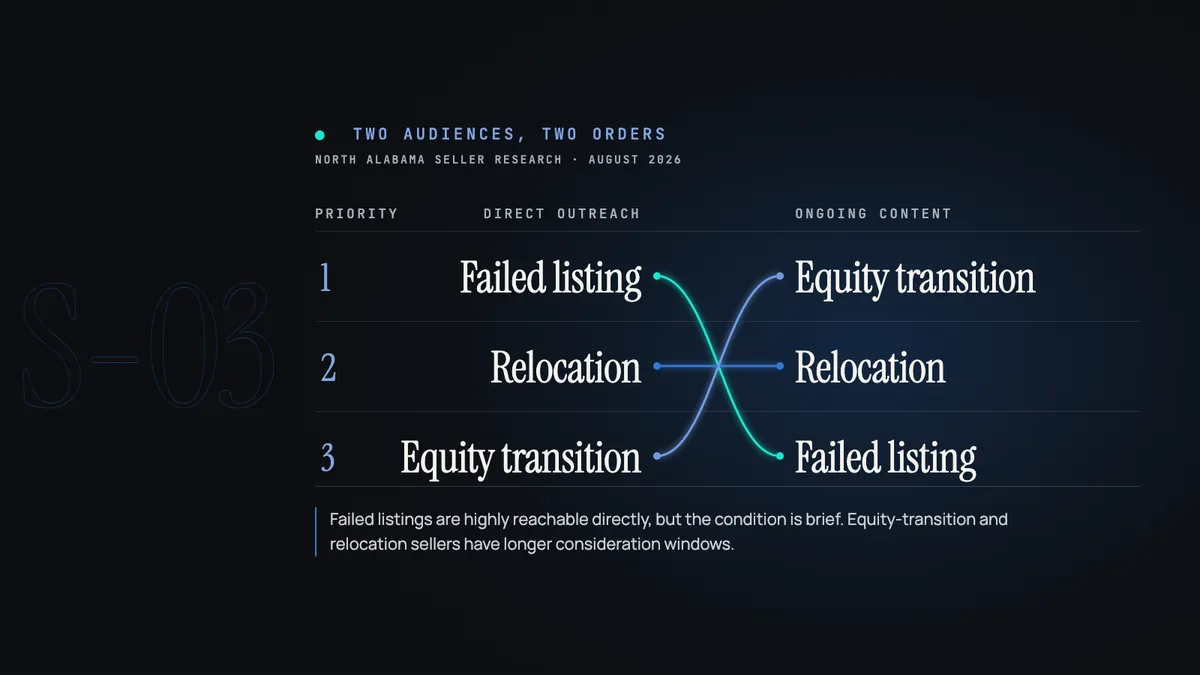
Two audiences, two orders
| Priority | Direct outreach | Ongoing content |
|---|---|---|
| 1 | Failed listing | Equity transition |
| 2 | Relocation | Relocation |
| 3 | Equity transition | Failed listing |
Failed listings are highly reachable directly, but the condition is brief. Equity-transition and relocation sellers have longer consideration windows.
Where the ongoing content goes
- 40% Equity and next-move decisions
- 25% Relocation seller operations
- 15% Failed-listing diagnosis and relaunch
- 15% Local market translation
- 5% Personal values and team credibility
What sellers are already asking
- “Should I keep my low-rate house as a rental or sell it?”
- “Should I sell first, buy first, make a contingent offer, or use temporary housing?”
- “What would have to be true for moving to make financial sense in North Alabama right now?”
Mortgage lock-in: A low current rate makes staying feel safe even when the house no longer fits.
Content response: Model the cost of staying and moving rather than saying ‘now is a good time.’
In the production plan, this became Scenario 01: Low-Rate Move-Up.
The plan changed what each video needs to explain.
That changed the videos we developed. One scenario asked whether a family should give up a low mortgage rate for another bedroom. The agent would explain his recommendation, work through the numbers, and identify what would change his answer.
The plan has Trevor Chapman, who leads Storyline & Sinker, change one fact on set so the agent can show whether his verdict moves. The plan below covers all 24 videos, the shot list for one of them, and the run of show for the shoot.
“Equity creates options. It does not automatically make a move wise. Every video must show a specific recommendation, the number or life circumstance controlling it, the dominant risk, and the changed fact that would reverse the answer.”
Eight scenarios × three styles = 24 vertical videos
- Low-Rate Move-Up The scenario below
- Debt-Free Downsizing
- Builder Incentive vs. Resale
- Fixed 75-Day Relocation
- Sell or Keep as a Rental?
- The Seller Cannot Reduce Again
- No Showings vs. No Offers
- Limited Equity, Strong Personal Reason
- A · Direct verdict
- 25–45 seconds. Attention; the agent’s willingness to disagree is the proof.
- B · Visual math (whiteboard)
- 45–70 seconds. The viewer sees the reasoning instead of only hearing a conclusion.
- C · Simulated consultation
- 60–90 seconds. Trust; labeled “Simulated seller scenario,” never a testimonial.
Scenario 01 · Low-Rate Move-Up Illustrative scenario
“A 3.1% mortgage is not automatically a reason to stay, and it is not automatically a reason to become a landlord.”
The numbers
- Current home
- $450,000
- Payoff
- $190,000 at 3.1%
- Next home
- $650,000
- The family
- Needs another bedroom
His recommendation
KEEP + BUY: keep the current home as a rental and buy the next one, only if all four hold:
- A real housing need
- The rental works
- Down-payment cash is separate
- Reserves remain intact
The risk
Excess leverage, inadequate reserves, or an owner who does not want landlord work.
What would change his answer
On set, Trevor changes one fact, and the agent says whether the verdict moves.
- All four hold KEEP + BUY
- The rent, the reserves or the separate down-payment cash fails SELL
- The extra room is not a real need WAIT
Shot list: video S1A, direct verdict
- Cold hook · 2–4 s
- Full master · 30–45 s
- Verdict pickup · 5–8 s
- Risk pickup · 5–8 s
- Switch pickup · 5–8 s · Trevor changes one fact
- Insert coverage · 6–10 s
- Engagement close · 4–7 s
Run of show, block shooting
- Crew pre-light 45 min
- Calibration (the agent + Trevor) 15 min
- Block A: direct verdicts 60 min
- Reset 10 min
- Block B: whiteboards 90 min
- Break + consultation reset 20 min
- Block C: consultations 120 min
- Universal CTA + pickups 25 min
About 5 hours of talent time.
- Set A · Direct (office)
- Set B · Whiteboard
- Set C · Consult (table, two chairs, practical lamp, real paperwork)
The shoot is complete only when each video can stand alone
- Clean hook
- Clean verdict
- One controlling number
- Primary reason
- Dominant risk
- Decision switch
- Style-appropriate CTA
The content was designed to help before the first call.
The content was designed to help homeowners recognize their circumstances and assess the agent’s judgment before contacting him.
We bring that same attention to your business. Before choosing topics, we look at how your customers decide, then weigh whether each finding changes who the content should reach or what it needs to explain.
Explore content creation, compare packages, or book a content call to talk through how your customers decide.